



-2.svg)


-1.svg)


Listen to the episode
Please hit subscribe wherever you consume our podcast ✌️
About the guest
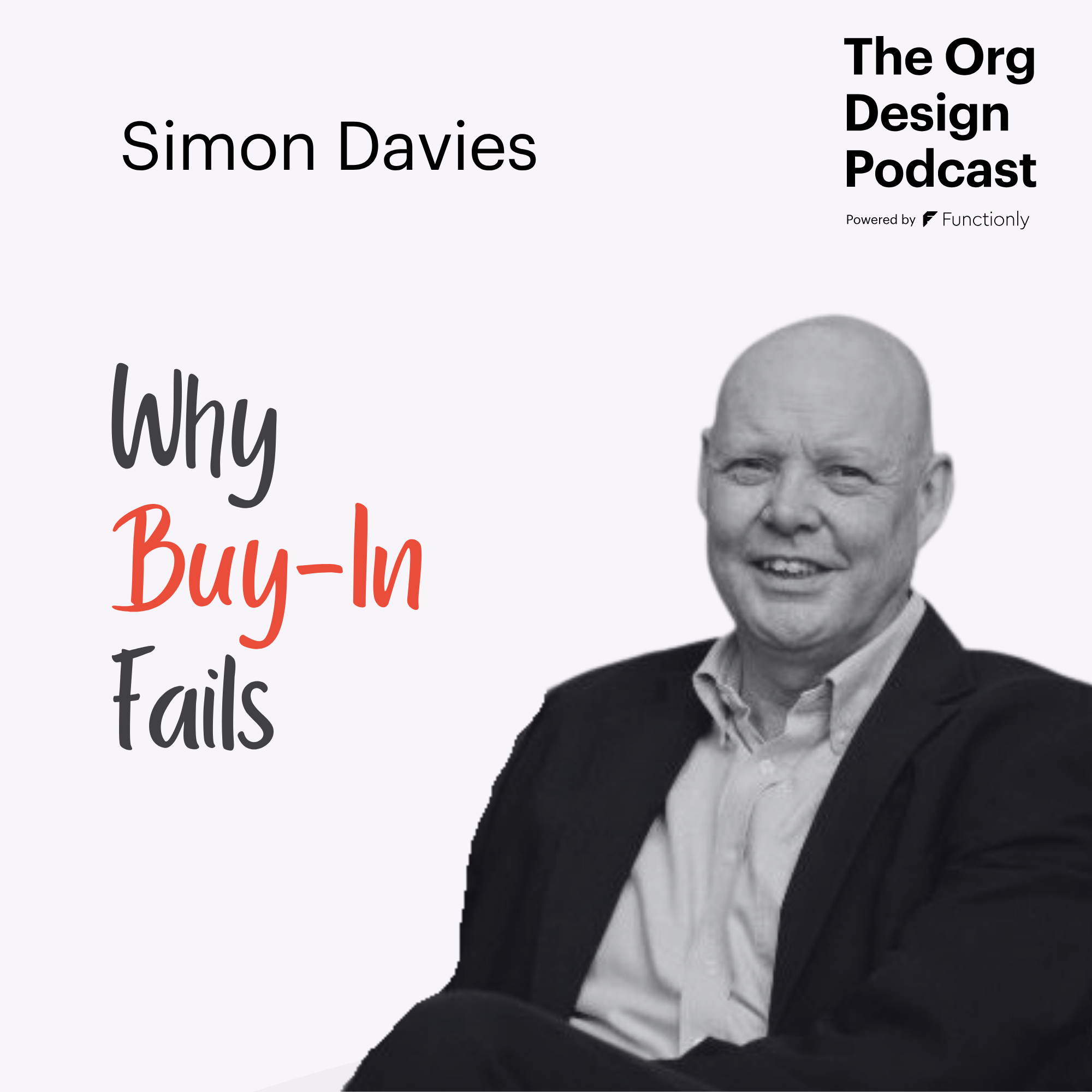
Simon Davies is a Certified Organisation Design Professional and Director of Northstar PS Ltd, with over 25 years of experience in leading transformational change across public and private sectors. He specializes in organization design, strategy development, and collaborative change, leveraging systems thinking to drive sustainable improvement in organizational performance. Learn more about him on his expert page.
Summary
This episode is a practical deep dive into how organisations actually change—not just talk about it.
Simon Davies (20+ years in org design across Europe and North America) breaks down why most “transformation” efforts fail, and what leaders should do instead.
The core idea:
You have two choices when leading change—force compliance or build commitment.
Simon argues that while top-down decisions feel faster, they create a long tail of resistance. A collaborative approach may feel slower upfront, but leads to faster, smoother execution because people support what they help create.
The conversation explores:
-
Why “buy-in” is a flawed concept
-
How to involve people without losing control
-
What an operating model actually is (in plain English)
-
The real signs your organisation needs redesign
-
How to structure change so it doesn’t become chaos
If you’re leading a team or organisation and feeling friction, misalignment, or stalled progress—this episode gives you a practical lens to rethink how change happens.
Transcript
Simon Davies EODF2024
===
[00:00:00] Damian Bramanis: All right, let's kick off. We are back. We are at EODF 2024.
[00:00:05] Tim Brewer: Good to see you Damian.
[00:00:06] Damian Bramanis: Thanks, Tim. Great to be here.
[00:00:08] Tim Brewer: In milan, Italy,
[00:00:09] Damian Bramanis: in Yes. That, that is the correct Milan. And we are here with Simon Davis, who is a member of EODF. And has been working in org design for a long time. I won't say how long because I don't know the exact number but
[00:00:24] Simon Davies: Shall we just say over 20 years
[00:00:26] Tim Brewer: over 20, 20 plus years experience.
[00:00:28] Damian Bramanis: 20 plus years experience across the UK, North America and Europe, and I'm really looking forward to digging in about, particularly about collaboration in org design.
[00:00:37] Tim Brewer: Oh yeah.
[00:00:38] Damian Bramanis: And so i'm gonna ask it as my first question. Where did you start to tell us your story about where you came across org design and your first sort of glimmers of interest in the field
[00:00:50] Simon Davies: Well, I started my career in general management in business. So, I came into this field from that direction, really transforming teams that were underperforming or not performing as well as they should and learnt by trial and error, what worked and what didn't. Tried some of the faddy theories that people would come up with. Read a book and try some of the things. Some things work better than others. And I kind of learned by experience. Then as my career developed, I got asked to go into more senior positions looking at organizational strategy and governance. And from that I started to enjoy working with leaders that were trying to transform their part of the business. And found myself in the field of being a consultant, not that I ever harbored an ambition to do that, but that's kind of where I ended up and I found I enjoyed doing the work actually facilitating groups and helping leaders be successful.
[00:01:53] Tim Brewer: you had a bunch of experience in different continents. Have you just traveled for work with different customers or have you had a chance to live in other places and work in different cultures?
[00:02:02] Simon Davies: when I was younger, my family moved to Germany, so I lived there for four years in my teenage years, which definitely played a big role in changing my worldview, because I, you know, I was a kid from the UK brought up in the UK system.
And suddenly I was taken out of that environment at the age of 15 and you had to sort of learn a new language uh, learn different culture You're an outsider. And I guess it teaches you a bit of humility as well that you kind of have to take a step back, And find your way. The other interesting thing was, I was thrown into, uh, an environment where expectation was high in terms of there was no limit on what you could achieve if you worked hard enough and your destiny was in your hands. So that's part. of my philosophy as well, and I think it goes for organization. Life too. But for my work I've been based outta the UK pretty much ever since then and all my travel has been to work with different clients around the world.
[00:03:10] Damian Bramanis: You mentioned transformation and that comes up quite a bit with org design. Can you give us a feel for the types of transformations you've been involved with?
[00:03:19] Simon Davies: Okay. So yeah, I think that the T word is a very overused one. And I've worked with organizations trying to do everything from, we are doing really well in the marketplace and we just need to get ourselves into a state where we can continue to do even better, to we are in real trouble. There's no future for the business. We need to radically change things if we are gonna if we're gonna find a future for ourselves.
I worked with one industry where they were doing pretty well at what they did. But the CEO and a couple of their senior executives had recognized that the way the world was going there wasn't gonna be so much demand for what they did in the future.
And, but they didn't know how that future was gonna play out. So they need, the challenge for them was how do we configure our organization so that we can tap into trends and rapidly assess whether they've got, some traction and configure organizational forms that. Are gonna enable us to to drive value from. them. And it was quite an interesting way of thinking about solving that particular Problem rather than how do we make ourselves more efficient get a bit more kind of outta the people we've got, maybe cut numbers, things like that.
Projects can be quite different. And transformation really for me is it implies some kind of big change. And it will depend on the situation you're in. And that's why I don't like the t word so much is because it's situational and what's a big change from one person's perspective is not that much for another.
[00:05:03] Damian Bramanis: Yeah. So when you are, at, I, I won't use the T word but when you are looking at something that's Quite a large amount of change for a significant organization and there's a realization that we really need to adapt because this is existential for the company.
How do you approach something like that from the beginning where you know that there's going to need to be a large impact across many people? How would you start down that process?
[00:05:32] Simon Davies: I have a fairly fundamental set of principles that I that operate by, and it's not the way every leader wants to lead change, but for me people are at the heart of this. So, I like to use collaborative change approaches. It requires leaders to really commit to that and to stay the course and expose some vulnerabilities as well. But fundamentally I believe people support what they help to create. And a lot of the wisdom know how and energy that you need to Really fundamentally change organizations already resides within the organization. If we can only tap into it and find a way to release it in a directed way, so that it's directed towards the energy, is directed towards achieving the goals we want, rather than dissipated across kind of conflict or working across purposes.
[00:06:34] Tim Brewer: If I was listening to the podcast and ran an organization, let's say 500 people, and I'm looking at my organization and feeling some of those things around maybe performance or the market's shifted, or we have to take a new product to market and I'm thinking, oh, we're gonna have to do some work to make sure my structure aligns with our. Our. Strategy moving forward, if I'm not naturally that collaborative, can you make that practical and how would you have that conversation with that leader or that executive team when you are talking through, Hey, we're gonna, I'm coming in to help you lead through this change. What are the practical things that any leader could start thinking about in terms of getting buy-in for their direction rather than just, top down control?
[00:07:18] Simon Davies: I'm glad you, mentioned the, my other word, buy-in, word which is my, pet peeve. And if I can use fruity language, 'cause I'm a brit, the bullshit word, the buy-in. As a leader driving change, you have two options. You can go for compliance, which is I'm gonna tell you what we're gonna do, and you can follow me, and if not, you can get off the bus.
Or commitment, which is we're gonna work this problem through together. We're gonna find a solution and we're all going to go together.
One's a pay now strategy. One's a pay later strategy.
So, you've got the choice, and I always say this when I'm talking with leaders, so let's cut the crap and get down to it, is you can make some fast, quick progress by having a small group of people in a room, figure out the what you think is the right answer and then go out into the organization and try and make it. So that's when you're gonna start paying. So you'll get fast start then a long tail of trying to persuade people, trying to police people, trying to re enforce what you're trying to, do.
Or you can invest that time, effort, and resource upfront with getting data looking at options, tapping into creativity of people. And then whatever you decide to do with that, the implementation of it is gonna be faster and smoother because everyone kind of gets what we're trying to do and has some equity in it because they help create it .
Now, that's not a free for all law, everybody's got a vote in how things go because the leader has to set the direction, so they set the requirements, the constraints, the parameters that we're working within so that everybody's efforts are directed towards.
How do we achieve that? But the challenge for the leader in practical terms is rather than thinking in solutions mode, is to think in outcomes mode. What is it we're trying to change? What is it that's gonna be different as a result of whatever we do?
And try and open the space up for different possibilities for how you might get there so that you, before you make a decision about one particular direction of travel, you've got your options that you can select from because people might come up with something that you hadn't thought about that might be even more effective.
[00:09:45] Damian Bramanis: I'm imagining if I'm a leader in that position and I was thinking about a more collaborative approach, that could be very confronting. The thought that people might air opinions, which are I see as dangerous or harmful? There could be information revealed, which maybe is going to hurt people's productivity. There's a, there is a siren going off. I'm sure that's coming across on the podcast. We.
Okay.
[00:10:11] Tim Brewer: they're almost here to get you Yeah,
[00:10:12] Simon Davies: Yeah,
[00:10:12] Damian Bramanis: that was a close call. It could be very scary if there is a some, like some information shared which suddenly could harm morale and make the situation even worse.
There could be other things that, that I really feel like it becomes out of my control in that sort of a situation. What would you say to that leader who's feeling those concerns?
[00:10:31] Simon Davies: I'd say they're legitimate concerns. But no changes risk free. A lot of your choice is situational. So I certainly would see if you were in a turnaround situation, where you had to make rapid decisions because the survival of the company is at stake or there's really confidential information then you, you'd have to think. Is a collaborative approach, the way to go firstly, so you've gotta be practical about these things. There's no one size fits all. There's no single right answer to this. But let's assume it's not that sort of situation. The sensitivity bit around sharing confidential information, potentially opening up discussions and debates. I think they're gonna happen whether you like it or not, right?
[00:11:21] Damian Bramanis: With you in the room or without with with you there
[00:11:24] Simon Davies: or without you there. And so this is why. I come back to the buy-in word. So organizations are great fooling themselves that if we just decide something we can tell and sell people into committing to it. And then people will play the game and nod their head when you're there, and then go out to the room and go out "it'll Never work" and then, and there's no commitment to it. I would say the, there are risks, but the other side of the coin is not risk free either. And it's about being pragmatic, about what situation are we in, how quickly do we need to move? And by the way, I've worked on organization redesigns, collaborative redesigns that are done in timescales of weeks, not months and years. It is perfectly possible to keep in control of the process by setting clear parameters and requirements and getting people involved in the appropriate way and to do it rapidly but it does require that commitment to to do it.
[00:12:24] Damian Bramanis: what does that process look like, to a fly on the wall and in a change, in a organizational design scenario? How would that fly know that this is a collaborative endeavor or not?
[00:12:36] Simon Davies: What you would be seeing is at each, it's almost like a decision tree. So you're making a set of decisions in you phase the work and you're making a set of decisions in each phase that start to guide the work of the following phases.
And you would normally start with a smaller group of people making some big strategic level decisions. So typically these would be the senior leadership of the organization that are setting the rules of the game the lines on the playing field that we are gonna play within.
[00:13:08] Damian Bramanis: What would an example of that be?
[00:13:09] Simon Davies: As I said earlier, they'd be setting things like, this is the strategic direction, here are the priorities. This is where we're gonna play, the markets we're playing in, not playing in. This is what our formula for winning is going to be. without getting too specific.
Some may be expectations on size of the organization, are we gonna be twice as big as in five years time are, we're gonna be half as big. So you kind of know the constraints and parameters you're working within. And then in the following phases, you start to get more and more People involved in coming up with options for how you would meet those requirements. And then as you get closer to operationalizing your design, you're getting more and more people involved. So the idea is as the white space, the sort of the area that people have freedom to operate in. Becomes narrower, because the decisions taken in the earlier phases, the more people you can engage in the process without losing control of it.
[00:14:13] Tim Brewer: We're at a dinner party and someone asked what you do for work, How do you explain this all design career you've created for yourself?
[00:14:24] Simon Davies: I have the equivalent of my family asking when they were younger, what do you do? And then their eyes glazing over as teenagers as you try to explain to them. I would say I help organizations fulfill their purpose by being really practical in translating, I see a lot of strategic intent statements, and fancy words on posters, but getting into really practical terms. What does that mean, what does the organization have to be able to do to deliver that strategic intent and then engaging the people, the hearts and minds of the organization to mobilize and create their own future and deliver it. So it's about helping those organizations to be successful in meeting their purpose and their strategic intent, whatever that may be, whether they're a for-profit or a public service or a charity.
[00:15:21] Damian Bramanis: What would be the things that an organization the fire alarms going off or the symptoms that they're seeing, Which would be the point where someone needs to get involved with org design?
[00:15:32] Simon Davies: I mean, there's lots of them. But if you are seeing kind of high levels of employee dissatisfaction, high levels of customer dissatisfaction you're losing market share. That you typically see calls for lots of initiatives, like we've gotta train people, we've gotta pay our people better. We've gotta put customer retention programs in place. These are point solutions for usually something that's a more fundamental problem, which is a misalignment somewhere in your operating model design that means that you are not well fitted to deliver on your strategic intent.
People think, well if we re-engineer the way the work works. and leave everything else the same, that's the answer. Or we retrain, reskill our workforce that will make the difference, and usually it's something much more systemic than that, that you need to sort of get underneath the hood as my American colleagues would say, and kind of see what's going on a bit deeper.
[00:16:35] Tim Brewer: Coming back to something you said earlier in the statement, what's an operating model?
[00:16:40] Simon Davies: Okay, well that's a really good question 'cause uh, lots of people have different opinions of what those are,
[00:16:47] Tim Brewer: how would you explain that to someone that's leading their couple hundred person company, and is oh yeah we, what's an operating like they're thinking the same thing.
[00:16:55] Damian Bramanis: I Heard about that? but I don't know what that is.
[00:16:57] Tim Brewer: I heard a consultant. Once talk about that at
[00:16:59] Damian Bramanis: at a dinner party.
[00:17:00] Simon Davies: Yeah. For me, an operating model is a pretty fancy word for describing something pretty prosaic, which is, it's the work that you ha have to do. By work all the activities and decisions that are made in creating value for the end customer, whoever that end customer is and whatever we call value for them, it's all of the tasks, activities, and decisions that go into creating that value. Because that's the only thing at the end of the day that creates value, is the work that we do.
Then the other leg of the operating model Is how we organize people and resources to do that work. And then there's another leg, which is how we manage and govern that work and those resources and join them up so that we connect them with our strategic intent And that we make the workflow efficiently through the organization.
And then finally thinking about how we gonna measure performance, how we gonna recognize the performance and the behaviors that we need. And it's almost like the recipe. Those are the ingredients. So the operating model is the. It's the sum of those ingredients. And if you get it right, you've got them all working collectively together to create a synergy.
And when you've not got it right, some of those things are not working optimally and they're impacting on all of the other elements. I'm sure you've even seen those things fighting against where you want the organization to go. Sure. Sure And things like, we want we want accountability and creativity in the organization.
And then you see management systems, which are getting people to fill out time sheets for accounting for every 15 minutes of the day, or they're not empowered to spend more than 50 pounds or $50. And you go your management's. systems are not congruent with kind of the behaviors and the culture that you are saying you're trying to create in order to achieve your strategic intent.
[00:19:09] Tim Brewer: How do you encourage leaders to think about org design success, do you help them, obviously they're looking at what their strategic content in is and what they want from that process, but how did, how do they know that they can feel good about. About the tail end of an org design project or process or culture?
[00:19:29] Simon Davies: Yeah, so for me, you have to start with the end in mind. I think as a leader you have to put some markers in the ground around, as I said before, what's gonna change as a result of this? What indicators do I want to shift? I don't think there's a kind. Of a ready-made. A basket of measures, But typically we'd be seeing organization leaders coming in, saying things like I want to affect things like my efficiency. I want to be able to grow faster. I want my people to be more engaged. So before we even start work, I would be saying to him, map out what are the outcomes you're trying to achieve. Not necessarily smart objectives, but. What's gonna change, what's gonna be different? And then I would ask the question, how would we know? So you start to get into what sort of things might, what measures might be telling us that we've actually achieved something. So you can create a baseline and then start to see how have we impacted. These things? But it's normally. Several indicators. It's not just one thing. So if you are, if you're thinking All I want to do is alter one performance indicator, then probably doing org design work? isn't really where your head's gonna. Be at
[00:20:45] Damian Bramanis: Yeah. More of a system.
[00:20:46] Simon Davies: It's more systemic, more holistic, more fundamental. Yeah.
[00:20:51] Damian Bramanis: a bit of a curve ball. If you could assign yourself a new job title, what would your job title be for what you do
[00:21:07] Simon Davies: That's a challenging curve ball. I, I think really to do what we do as kind of organization design consultants working in a collaborative approach now, rather than going in, telling people. How to, do it as it were. You've gotta be a bit of a like a tour guide for i, I described it the other day to someone is you know all of the places you've gotta hit on the tour.
But sometimes you've gotta be adaptable. You're going to take your party down one one way, you're gonna go via different places so you are a bit like a tour guide going through through the journey that the leadership team and the organization are going on where your job is to help them make the right decisions at the right time and Make sure that they're having the right quality of conversation, but you don't have the answers for them. So it's you're just there to show 'em the route and they can enjoy the journey and and visit, and get as much out of the places you'll visit. I'm probably stretch that metaphor too far
[00:22:15] Tim Brewer: no, I think org design tour guide works. That's really good. That's really cool.
[00:22:19] Damian Bramanis: If If people are interested in what you've talked about today and I want to learn more about you or about what you've spoken about. What's the best way for them to find out more or get in contact?
[00:22:28] Simon Davies: they can either find me on LinkedIn, by all means reach out.
[00:22:32] Tim Brewer: Fantastic. And how would a. Leader listening in know that they're a good fit For the style of consulting you do?
[00:22:38] Simon Davies: If they've got an appetite for opening themselves up to different possibilities they don't think they've got all of the answers. That they're willing to have a bit of vulnerability as we we talked about. And they know what success might look like, but they are open to different routes to get there, then that's a good fit if they think they've got an intractable problem. We've been trying for years to solve. and never Quite cracked it. That's probably a good indicator, that a different approach might be helpful.
[00:23:12] Tim Brewer: Simon, thank you so much for joining us on the org design podcast. It's been such an interesting discussion. I really appreciate you, letting us ask so many questions. I'm sure it's interesting both for the listeners that are joining us, but it's been super interesting for us. I know we've both been bouncing off each other with questions.
[00:23:32] Simon Davies: It's been a pleasure and and I've enjoyed answering the difficult questions you throw my way, including curve balls.
[00:23:39] Tim Brewer: No, I, think it's been the most important thing for us is it's important for our listeners. I think there's been some really great. Practical helpful topics for them. So thank you for joining us, Damian, and to all our listeners. Thanks for joining us on the podcast. Have a great rest of the day.
Functionly empowers organizations to navigate the complexities of organizational design by providing tools that encourage collaboration and transparency. By enabling leaders to visualize their organizational structure, Functionly helps facilitate the alignment of teams with strategic goals, making it easier to tap into the collective wisdom of employees. This collaborative approach fosters a culture of shared ownership and commitment, allowing organizations to adapt and thrive in a rapidly changing environment while addressing performance challenges effectively.