
-2.svg)


-1.svg)


Listen to the episode
Please hit subscribe wherever you consume our podcast ✌️
About the guest
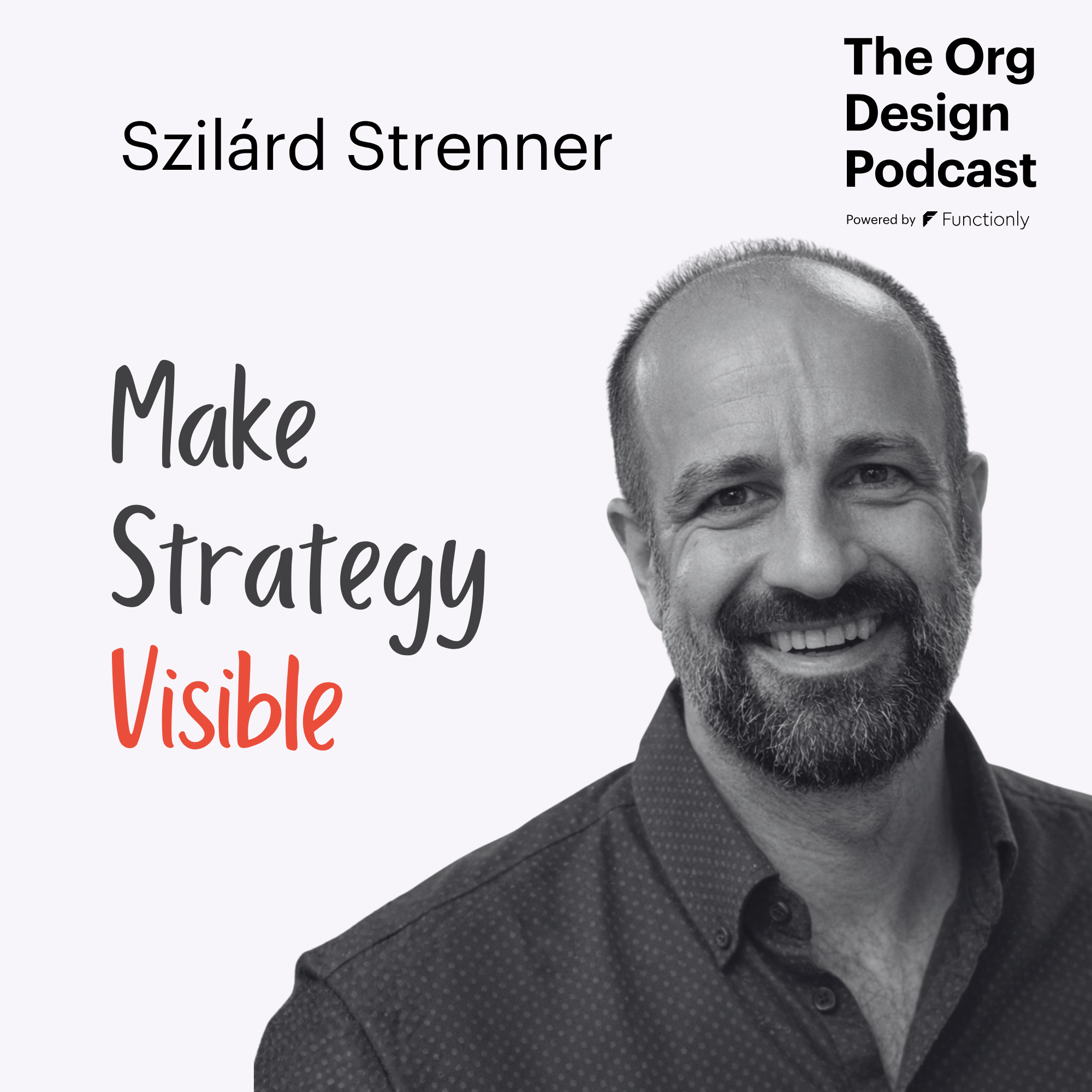
Szilard Strenner is the CEO and senior consultant at Grafacity Visual Services, specializing in visual facilitation and organizational development. With over 30 years of experience, he helps teams navigate change through innovative visual methods. An active member of the International Forum of Visual Practitioners, Szilard combines artistic skills and systems thinking to make ideas visible and facilitate effective decision-making. Learn more about him on his expert page.
Summary
Most org design work disappears the moment the workshop ends.
In this episode, Szilard Strenner explains how visual facilitation turns strategy into something people can actually see, engage with, and remember.
Instead of flipping through forgotten slide decks or buried documents, visual facilitation uses large-scale, pre-designed templates and real-time visual recording to help teams think together, align faster, and retain decisions.
The key idea:
👉 Great facilitation isn’t about what happens in the room—it’s about what’s designed before it.
Szilard shares how:
- Visual structures guide thinking and decision-making
- Physical interaction (moving cards, filling space) drives engagement
- Preparation (not improvisation) is what makes facilitation effective
- Strategy can live beyond the workshop as a shared, visual “one-pager” across the business
For leaders doing org design, this is a shift from:
- Slides → Shared artefacts
- Talking → Co-creating
- Outputs → Alignment
Transcript
Szilard Strenner - EODF
===
[00:00:05] Damian Bramanis: Welcome to the org design podcast.
[00:00:07] Tim Brewer: Good to be here, Damian.
[00:00:09] Damian Bramanis: Thanks Tim. Good to be here too. And today we have Szilard Strenner who is joining us from Grafacity and really excited to about a couple of different topics today. We're coming live from Milan, so welcome Szilard.
[00:00:27] Szilard Strenner: Thank you for in the invitation and the possibility to talk about visual practices.
[00:00:31] Tim Brewer: One of the things that's gonna be a little bit difficult for people that are just listening on the podcast versus watching the podcast on YouTube, which for those who don't know, we do publish all the podcasts there. This behind Szilard today is one of his bodies of work from the conference.
So maybe Damian, if you describe that for people that are just listening along in the car, or on their headset what you can see behind it. 'cause it's very impressive. But we're gonna have to tell a visual story.
[00:00:58] Damian Bramanis: So imagine the notes that you took at school, but multiplied by 10,000. So we have in front of us a huge sheet of paper, which is larger than a person lying down.
Imagine the entire, almost a wall size piece of paper, and it's got pictures all over it of moments that happened in a presentation. There's the presenter themselves. There's things they talked about. There's highlights from their slides, and we have an explosion on drawn on the screen. We have strategy drawn on the screen. We've got people cheering. We have planet Earth, we've got charts and it's an explosion of color and text to remind people of everything that happened during that presentation.
[00:01:41] Tim Brewer: Szilard's here at conference as a visual storyteller, but today we're really interested in org
[00:01:49] Damian Bramanis: as a visual expert.
[00:01:51] Tim Brewer: visual storyteller.
[00:01:52] Damian Bramanis: Visual storyteller.
[00:01:53] Tim Brewer: He's also visual facilitator. Yes. We've been meeting with lots of experts around org design, a lot of them are great facilitators, but we think it's a really unique way to help someone go through the process of org design or going through that facilitation process.
Maybe we'll go all the way back to the start. How did you get into this kind of visual work and mixing that with facilitation. Where did it all start? Did you wake up? Yeah. I want to be a visual org design facilitator, or how did things come about?
[00:02:28] Szilard Strenner: Yeah. Okay. So good morning. Okay, so I let's going back to the visual, which you just explained, Damian. Thank you so much. So this is what we usually call a, a scribe or a visual recording. It's passive. Actually, it's when you were at the school or the university, you take notes in your notebook. It's nearly the same because the teacher was there doing his presentation. When you do the scribing you listen, and then you put the content, the key keywords on the paper. You might even use bullet points, not as fancy as mine, but still you do the recording, do the scribing, you jot down what has been said on the way. When you're on the go, I do the same
[00:03:08] Damian Bramanis: for everyone at home, the bullet points look like shiny red balls, which are glistening with light and have shadow.
[00:03:15] Szilard Strenner: Yeah, And shadow and drop shadow on the paper as well. So what is here is that if you have a larger piece of paper, if you have more proper tools, then you can really do the job.
Because this was the change, the big transformation to me because people knew that I was always drawing and scribing on my training because I, coming from the youth work field as a non-profit trainer. I've been doing volunteer management trainings, et cetera, and all my trainings were in the venue, were covered the room with full of flip charts and wrapping papers, all sort of things. But with the traditional markers, you cannot really do the same thing. And then in 2010, when I graduated as an OD consultant, I had the privilege to work together with Sabine Soeder, a German based visual facilitator. And then she introduced me the Neuland markers, which are in many colors, I dunno, 30, 40 different colors, refillable markers, and even the nibs could be changed if it's broken.
[00:04:19] Tim Brewer: Wow.
[00:04:19] Szilard Strenner: So it's really cool
[00:04:21] Damian Bramanis: stuff.
I can see on the board there, there's some very pale gray, which is just to add a little bit of a hint or there's multiple colors of red to add dark and light and shadow to things. So there's not just one or two colors here. There's quite a depth.
[00:04:34] Szilard Strenner: Quite, quite, yeah. And then yes, you can do the scribing with two colors, black and white. Or you can, if you Google and look for the works, for example, for Kelvy Bird, she's working on black paper with white and gray and gold and yellows and all sorts of things working for Otto Scharmer in the Presencing Institute. And her work is just completely different from this kind of literal graphic recording, visual recording. So now going back, I was introduced to the tools, the large papers, and then, and the boards. Because usually in hotels it's not possible to have something beyond the flip chart and it's small.
That's the trouble, what I see in consulting processes, that you have a flip chart and full stop, and it's not big enough. To suck in the thoughts of 20 people. You take, you might take notes and then you page and then you page. Yeah. And then you page and half an hour later you try to find what you have put on the paper.
You flip it back forth, back and forth. Oh, where is it? Or the trainer may even cannot read what is written on the, on it. So that's why proper legible writing is another key.
[00:05:43] Damian Bramanis: I've seen that because the paper's so large that you can connect things together. Yeah. I've seen you draw lines and attach things from previous parts that might have happened 10 minutes ago.
[00:05:53] Tim Brewer: I reflect on what I saw yesterday is people would come and just stand and slowly go back through the arc of someone's presentation or in your case facilitation.
I've seen, we've seen something similar a lot and you've probably seen that where people take sticky notes. They put all the sticky notes over a glass wall where they can go and really stare and take in all the information. This is really the next level. When you've created a visual expression of what's happened over a facilitation.
Facilitating is hard.
How do you facilitate? And draw at the same time? Or is that just something that's come with time? So if you are helping someone, if someone said, oh, we're going through org design process, we'd love you to come and facilitate and draw, can you only only do the visual facilitation? You can't lead like an org design process or have you worked out a way to do a bit of both when you are leading a facilitation.
[00:06:52] Szilard Strenner: yeah. Clear. Okay. Let's let's dive into this because this is very important. Most often the visual practitioners as we call our tribe, are seen on next to the stage doing this kind of realtime visual recording. This is what most of us are doing, but me as a designer because my first university paper was furniture design.
So those who think in processes, we know that preparation is the key. So when you are thinking and designing the agenda of an event, you immediately have a separate column in the paper and put what visuals could help the people? What is a poster? What is a welcome poster at the entrance? For example, how to greet the people. Where are the restroom or where is the eating area? Where is this an information that needs to be pushed?
And then, what is the part of the agenda where people will be thinking and we need their thoughts. So that's where templates are coming. If you open up this training booklet, I just brought one, there is a full chapter on templates. Templates are these empty structures.
So for example, here this is a special conference because half of the process is open space technology. You might know this is come coming from Harrison Owen who thought people are here for the lunch and the buffet and to meet people.
Yeah. So let's turn conferences inside out. And then he designed the open space. That's what we have now to make real conversations. So that's a poster, that's also pre- prepared, pre-made before the conference. This is what we have done together with my colleagues years ago.
Okay. Then here comes the empty structures. David Sibbet, an old friend of mine from Grove Consultants he has developed the, that's The Grove Consultants International from the San Francisco Bay area. Yeah. Nice. Very old chap. They applied this kind of empty structures to support visual facilitation because they know the process, what is coming ahead? So for example, now we are going to design an annual strategy of the departments of human resources, operations, procurement, client management, et cetera.
[00:09:06] Damian Bramanis: So for what we're seeing here for everyone at home? Yeah. There's a page on the on here, which has a few different templates that have And so before the event, these have been drawn with a large arrow with lanes on it that point off into the ocean. And then there's, oh, it looks like a sunrise out in the distance with the bubbles there. And all of this is a graphical layout, but there's space to put in the content from when the session actually happens.
[00:09:32] Tim Brewer: I'm a fairly visual person, and when I see that image, I immediately know my brain goes to, oh, I know what we're up to. It puts me in the mind space to start planning with a blink of the eye at that image.
And I think it's really, really understated how important for a, quite a big number of the people in the room. Some are really verbal, some are really written, they wanna read all the content prior to going into a meeting. But I think bringing in this visual element into org design or into the org design facilitation process is really important for a big group of people that attend. So bringing this in I, I think, is such a powerful thing. We see people trying to do it, drawing on themselves, but to go to this next level of having someone come and assist visually, I think super, super interesting
[00:10:20] Damian Bramanis: I was actually thinking I'm a, I care a lot about time and location and looking at this I would be, oh, are we behind or ahead of the agenda because I know what we need to cover in the rest of the time that we've got allocated here.
And then I can see there's this much space. So this is the big thing that we need to cover because there's lots of space for it. And this is the final point because it's what the arrows are pointing to.
[00:10:42] Szilard Strenner: Yeah. Okay, so if we go back, so why these structures are especially good for managers and who are in the industry. These are diligent people who want to accomplish, so they see an empty space. Let's fill it. Let's prove that I can do, I have plans. Hey, boss, here is me. And then they are working on the deck, on the deck cards or on post-its fill up what they plan, what they think would be good for the department, for the whole company. And holistically they can they can feel the structure and then they can immediately box, and then make agreements and arrangement in a holistic way.
Instead of on PowerPoint or in Excel, you cannot really do this. Even if you see it on a big large screen you can't move the boxes, you can't move the cards. But with this old traditional Stone age, things like BluTac and the piece of cardboard with your hand written, it's, it is just completely different.
And then, when I know that the group is going to create a strategy for them. So that's what we are contracted for, I do build the team, so there is trust, and then I design the process, I design the visual, the physical material that they are going to working on it, and lean back the floor is yours guys, and then they are start to working on it for a half a day or I only need to maybe remind them of the time is passed by.
[00:12:12] Damian Bramanis: So are you saying sort of for facilitation, it's about the preparation beforehand that really makes the facilitation successful.
[00:12:17] Szilard Strenner: Absolutely. Yeah. Absolutely. And that is why it's a field of knowledge and the field of different things. For example, this is the Belbin team role model. You just put the big template on it each and every person in the management team has a card with his face on it. And then they can immediately see how many people are in the, I dunno,
[00:12:38] Damian Bramanis: so what we're looking at here, there's a large circle that's divided into different slices, like slices of a pizza, and each slice of the pizza has got a picture in it. So there's a picture of a telephone, there's a picture of a light globe, there's a picture of an eyeball, a picture of a spanner and so on. They go around there and in the middle there are lots of pictures of people which have been dotted around on that pizza.
[00:13:03] Szilard Strenner: Yeah, this is actually that the Belbin team roles model that you can find anywhere and then you can easily find the Belbin team role test. So you can, you will see immediately how many shapers, how many leaders are in your group, how many operation managements, etc
[00:13:19] Tim Brewer: I think the other thing we've talked a lot about at the conference is org design being strategy first or people first and the balance that you hold between those two things. And let's take the Belbin team models, the action of going and putting something up on the board or the action of writing something, is very engaging for people. So they get to the end of the day and they've participated in the build of material, which I think is really important.
Question for you, so we have most of our audience are leaders with org design challenges or problems looking for solutions? How do they know if they're sitting today listening to the podcast, thinking actually we've got a good idea of where we're going on a super engaged team. It sounds like a really interesting way of engaging the team in a facilitation, how would they know they're a good fit for you? Do you travel anywhere in the world or is it just, I know you're based in Hungary at the moment. Tell us a little bit about how, if someone's listening along that they're a good fit for your style of work.
[00:14:21] Szilard Strenner: Okay. Yeah. And then one more thing, which is, which I think is important. Visual facilitation it doesn't end at the process. So when, I dunno, we are at Fridays, 6:00 PM then we are done shake hands, and then I give the papers to the people and maybe send them the photos. That's not the end.
What is doable is that once we have the strategy, so in every quarter everybody knows, or in monthly chapters, we know, where to, what to do. It can be easily put into digital. We can draw it. And then each and every department, even the reception will have the same vision.
So everybody will talk about the same one pager and they will get the strategy and then all the people will be aligned with it. So going back, yes, I think those companies who are beyond, I dunno, a few hundreds of people, they need this kind of one pagers. They need this kind of thinking structure, these models that will shepherd the processes and, they can they can use them. What I really don't understand how consultants engage people without that kind of big structures because we have these speaking sessions, we have the rollouts, and then the PowerPoints are saved in the archives and then then they're gone.
[00:15:38] Tim Brewer: filing, Filing cabinets, throw stuff away and filing cabinets forever
[00:15:42] Damian Bramanis: I know we're running a little bit short on time, but I've got a question I just have to ask. It's about the trust that's placed in you on how you decide what's important because looking at what's behind you there. Some things are large and colorful. They've taken up lots of space. Some things are just small items in the corner, which are smaller text or don't have big pictures at all. And some, there's not enough room to write every word. How do you choose what needs to be really prominent and bright and colorful and and visual and what things are just written as text or what things are left off?
[00:16:14] Szilard Strenner: thanks to my secondary school English teacher, I can understand this international language. So this is one thing that I understand more or less. The context and thanks God, in the last 15 years I'm in the business. Before that, I was in a non-profit organizations and working with youth organizations and communities, and I have some experience in the governmental sector as well.
So what I notice here is. Sometimes that is a challenge between with native speakers who they refer to and use kind of slang and then refer to something which is, ah, what the heck are you doing? But then usually what I do is that, for example, here I invited David, when he was done from this from the stage. And then we have gone through the visual notes. Oh. And then checked everything.
So with the common sense, I just. I'm just hearing, okay, this is important. I also notice the audience, how do they react to these kind of things? And also for the, for example, with the questions. So you see there is a big bullet, big red bullet point here, which is the header of this section. This is reflections and questions and each and every comment and thought is covered with a bullet, with another bullet
[00:17:29] Damian Bramanis: so visually you can see that all of those things are part of the same the family.
Yeah. Yeah. Yeah. Yeah.
[00:17:34] Szilard Strenner: If I'm hearing. Someone returning to one single point, especially, if the conference, for example, on sustainability and then we are going back and back again, then I can add the yellow, then I can add the rays to that. So something is coming out and shouting. I'm important.
Thank you so much
[00:17:52] Tim Brewer: Szilard it was so good to have you along. I think it's such a, interesting way to engage people in org design facilitation alongside the podcast on your author page will make sure your contact details are there. So people that are interested in using visual facilitation as a part of their org design process can get in touch. It's been really great meeting you at the conference and seeing your work. Damian, thanks for joining us for another episode of the podcast coming live from Milan.
[00:18:22] Damian Bramanis: Brilliant. Thank you so much, Tim. Thank you so much Szilard.
[00:18:25] Szilard Strenner: Thank you so much, all the best.
[00:18:26] Tim Brewer: See you everyone.
[00:18:27] Damian Bramanis: Bye-bye.
[00:18:27] Szilard Strenner: All the best. Take care.
Functionly empowers organizations to enhance their visual facilitation processes by providing a structured framework for designing and implementing organizational strategies. With its user-friendly tools, Functionly enables teams to visualize their goals, streamline collaboration, and maintain alignment across departments. By integrating visual templates and real-time updates, Functionly ensures that all team members stay engaged and informed throughout the organizational design journey, allowing for seamless adaptation to change and fostering a culture of continuous improvement.